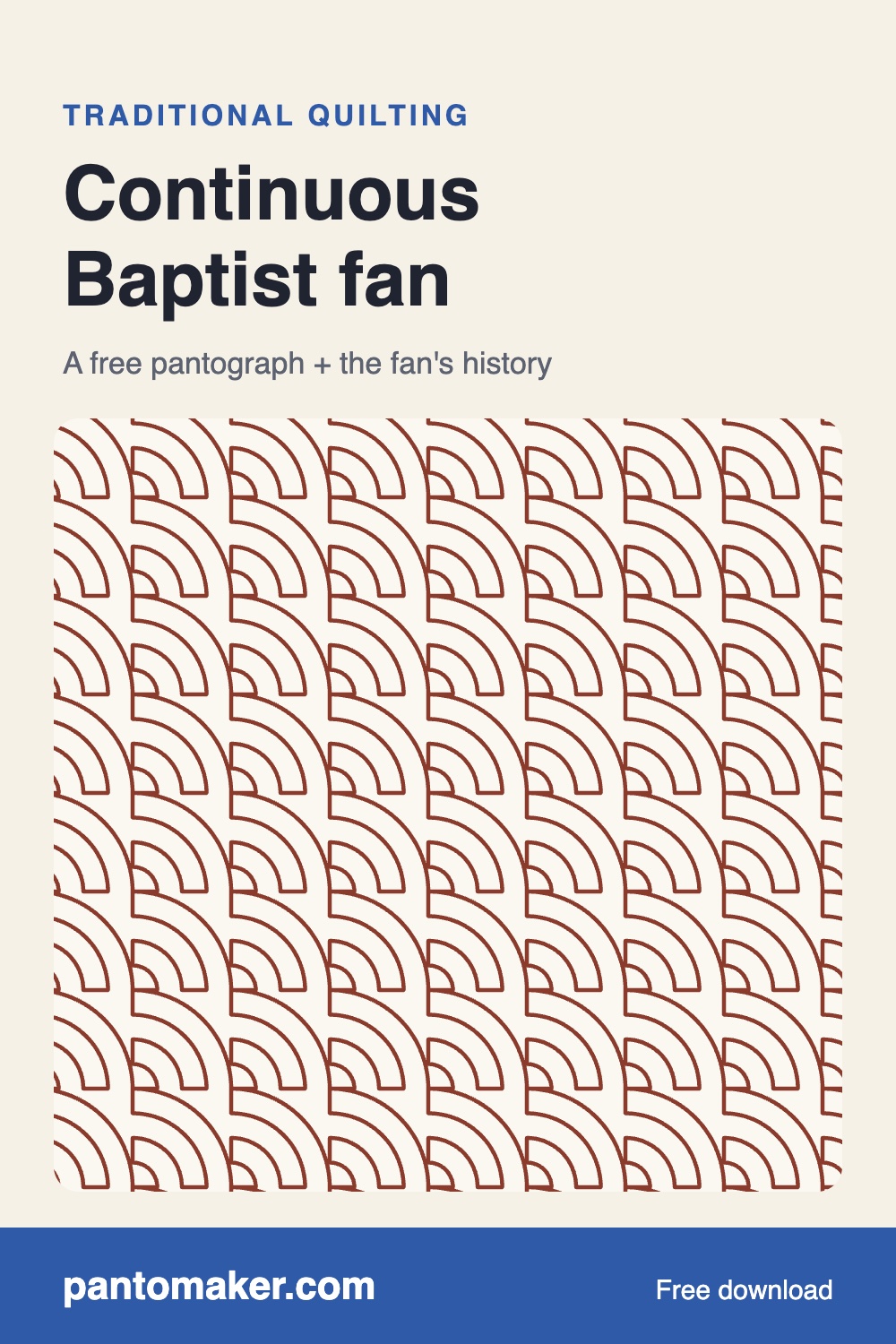
Free Baptist fan pantograph
A continuous Baptist fan edge-to-edge design, free in every longarm format (QLI, HQF, IQP, DXF, PAT, BQM and more) with a paper pantograph to print at home. Use it on any quilt, including quilts you sell. Below: the download, how the design runs on a longarm, how to change the arcs and size, and where the fan comes from.

The download is a 15 in repeat with 5 in rows: three fans per repeat, four arcs per fan. To change it, open the Baptist fan in PantoMaker; the classic designs are free at any size.
What a Baptist fan is
A Baptist fan is a row of fans, each made of concentric arcs swung from one corner, repeated across the whole quilt. It was one of the most common all-over quilting designs on everyday utility quilts, especially in the American South. Nobody can say for certain where the name comes from. Suzanne Labry, writing in Suzy's Fancy on quilts.com, calls the true origin impossible to verify and notes that other sources name Methodist, Presbyterian or Lutheran fans, perhaps after whichever church was strongest in the area. Two stories come up again and again:
- Church quilting. Quilts set up in a frame in the church basement for fundraisers and quilting bees, as told on Longarm University's "Quilting in Circles" page.
- Church fans. The shape looks like the cardboard hand fans handed out in churches before air conditioning, often printed by funeral homes and insurance companies. Both sources mention this one.
The way it was stitched explains why it lasted. Hand quilters marked the arcs with a homemade compass: a knotted string, one knot held at the corner, a pencil or chalk in another, one arc per knot. Some skipped marking and swung the arc from the elbow, spacing the smaller arcs a finger apart. Labry points out that the arcs follow the natural movement of the arm, so the quilter keeps sewing in one direction without twisting. Because the arcs were worked from the edges of the quilt inward, they often didn't meet in the middle, and many older quilts show a thin strip down the centre where they missed. Texas quilters called it "the hog's back".
These accounts are family memories and quilting lore rather than documented history, and both sources say so.
Continuous for a longarm
A longarm or a computerized system stitches a pantograph as one unbroken line, so PantoMaker's Baptist fan is drawn without stops or jumps:
- Inside each fan the line sweeps an arc up from the baseline, steps up the fan's left edge, sweeps the next arc back down, steps along the baseline, and so on, from the smallest arc out to the biggest.
- From fan to fan the outer arc ends on the baseline exactly where the next fan's corner starts, so the fans link without a jump stitch. That's why the arc count is always even: the line has to finish on the baseline.
- Row to row the fans are as wide as they are tall at the default size, so with the row spacing equal to the row height, the top of each fan meets the corner of the fan above it and the rows lock together in a grid.
Each file is one repeat that starts at the left and ends level on the right, so your quilting software can repeat it across the row and stack the rows. For a different look, tick Shift every other row half a repeat in the preview. With three fans per repeat, that offsets every other row by half a fan.
Changing the arcs and the size
- Arcs per fan. The Arcs per fan slider goes from 2 to 8, in even steps (2, 4, 6 or 8) so each fan ends on the baseline. At the default size, four arcs are 1.25 in apart; eight make a dense, textured fan, two a very open one.
- Fan size. Each fan is the repeat width divided by Motifs per repeat. A 15 in repeat with three fans gives 5 in fans. For round fans, keep the row height equal to the fan width; a taller row stretches them into ovals. When you open the design, set the repeat width and row height under Size to the size you want (15 and 5 in to match the download).
- Density and batting. Bigger fans stitch faster and leave the quilt softer; smaller fans and more arcs quilt denser and stiffer. At 15 × 5 in with four arcs, no open patch is wider than about 1¾ in, well within most battings' maximum stitching distance. If you scale the fans up a lot, check the number on your batting's package.
For row heights that fit your machine and the number of rows on common quilt sizes, see what size pantograph do I need.
Quilts it suits, and thread
The Baptist fan is at home on scrappy quilts, vintage and reproduction quilts, and quilts made from old blocks or feed-sack prints, where a traditional all-over texture looks right. Because the fans ignore the seams, it also works on busy piecing where you don't want to quilt each block.
- Blending thread (a neutral tan, cream or soft grey) lets the fan read as texture and keeps the piecing in front.
- Variegated thread suits the long, smooth arcs and shows the fans off on plain or low-contrast quilts.
- A darker accent colour, like the rust on this page's pin, makes the arcs a feature on solids.
Paper version
Every download includes a paper pantograph. For a hand-guided longarm, print the paper pantograph on Letter or A4 sheets and tape it together, or print it as one long page at a print shop, then follow the line with your laser or stylus. If you change the size or the arcs in PantoMaker, the paper version is made at your new size. The other classic designs are on the free pantographs page.
Before you stitch
As with any new pantograph, load it on your machine, check the size your software shows, and stitch a test row on scrap fabric first. If something looks wrong, email support@pantomaker.com with your machine and software version.