Charity quilt sizes, and quick edge-to-edge quilting for them
Most charity quilts fall into three groups: Project Linus blankets for children (about 40 × 60 in is typical), Quilts of Valor for service members and veterans (60 × 80 in recommended), and NICU and isolette covers, whose size depends on the hospital. Below are the published guidelines for each, a summary table, how many edge-to-edge rows each size takes, and free designs that quilt a donation top quickly.
PantoMaker is not affiliated with any of the organizations below. Their guidelines are summarized from their own pages, checked November 5, 2026. Organizations and local chapters can change them, so check with the group you're giving to before you start.
Project Linus blanket sizes
Project Linus gives new, handmade, washable blankets to children from 0 to 18. Its FAQ (checked November 5, 2026) says:
- Smallest: about 36 × 36 in.
- Most common: about 40 × 60 in, which it calls crib size.
- Largest: up to twin size, for teens.
Local chapters may ask for something narrower, depending on the hospitals, shelters and other places they give to. Your chapter's coordinator can tell you which sizes they're short of.
Quilts of Valor sizes
The Quilts of Valor Foundation's basic requirements (checked November 5, 2026) set a minimum of 55 × 65 in, a recommended size of 60 × 80 in and a maximum of 72 × 90 in. The quilt must be machine or hand quilted; a tied quilt isn't accepted. The fabric, backing, binding and label rules are in the Quilt of Valor size requirements guide.
NICU quilts and isolette covers
There is no standard size. An isolette cover drapes over the baby's incubator to keep out light, so it has to fit that hospital's isolettes, and each unit sets its own size and materials. Two examples, both checked November 5, 2026:
- Bronson Health (Michigan) lists isolette covers at 40 × 50 in on its handmade items page, with a dark bottom layer, quilted or thick enough to block light, sturdy enough for hospital laundering, and no tied quilts.
- Quilters Unlimited of Tallahassee, a guild that sews for its local hospital, lists isolette covers at 40 × 60 in finished on its neonatal quilts page.
Sizes and materials vary from hospital to hospital. Call the unit, or the volunteer office, and ask for their current size, fabrics and washing rules before you cut anything.
Charity quilt size chart
| Quilt | Size | Source |
|---|---|---|
| Project Linus, smallest | about 36 × 36 in | Project Linus FAQ |
| Project Linus, crib size (most common) | about 40 × 60 in | Project Linus FAQ |
| Project Linus, teens | up to twin size | Project Linus FAQ |
| Quilt of Valor, minimum | 55 × 65 in | QOVF basic requirements |
| Quilt of Valor, recommended | 60 × 80 in | QOVF basic requirements |
| Quilt of Valor, maximum | 72 × 90 in | QOVF basic requirements |
| Isolette cover | varies by hospital (40 × 50 and 40 × 60 in are two examples) | ask the unit |
All sources were checked November 5, 2026. Local chapters and hospitals set their own rules on top of these.
Rules beyond size
- New and washable. Project Linus asks for new, handmade, washable blankets, and donated materials must be new and free of mold, mildew and smoke.
- Smoke- and pet-free. Project Linus asks that blankets be free of smoke and of pet hair.
- Quilted, not tied. Quilts of Valor must be machine or hand quilted, and some hospitals (Bronson, for one) don't accept tied quilts either.
- Built for the laundry. Hospital quilts go through industrial washers, so quilting that holds the layers together matters more than on a wall quilt.
- Ask first. The group you give to has the final word on size, fabric, batting and labels.
Quick edge-to-edge quilting for charity quilts
An edge-to-edge pantograph is the fastest way to finish a stack of donation tops: one design, one thread, row after row. A few things help:
- Pick a simple, open design. Meander, waves, hearts and stars suit almost any piecing and any age, and an all-over texture hides wobbly seams.
- Keep the density right for washing. Check your batting's package for the widest gap it allows between lines of quilting and keep the design within it. What size pantograph do I need? explains how.
- Use one thread color. A mid-tone that blends across the top, like cream, light gray or tan, saves rethreading between quilts.
How many rows each charity size takes
These counts come from PantoMaker's own layout code, the same one the designer uses, with a 12 in repeat, rows that touch (row spacing equal to row height) and each row running 2 in past every edge of the quilt. The row count doesn't depend on the design, only on its height and spacing.
| Quilt | Repeats per row | 6 in rows | 8 in rows |
|---|---|---|---|
| Project Linus, 36 × 36 in | 4 | 7 | 6 |
| Isolette cover, 40 × 50 in | 4 | 10 | 7 |
| Project Linus crib or isolette cover, 40 × 60 in | 4 | 11 | 9 |
| Quilt of Valor minimum, 55 × 65 in | 5 | 12 | 9 |
| Quilt of Valor recommended, 60 × 80 in | 6 | 15 | 11 |
| Twin, 70 × 90 in | 7 | 16 | 12 |
| Quilt of Valor maximum, 72 × 90 in | 7 | 16 | 12 |
The twin row uses PantoMaker's Twin preset; Project Linus doesn't give exact twin measurements. To check your own size, open a design in PantoMaker, set the repeat width and row height under Size, then type your width and length under Your quilt. The line under the preview shows the rows, the repeats per row and about how many yards of stitching it takes.
Free designs for charity quilts
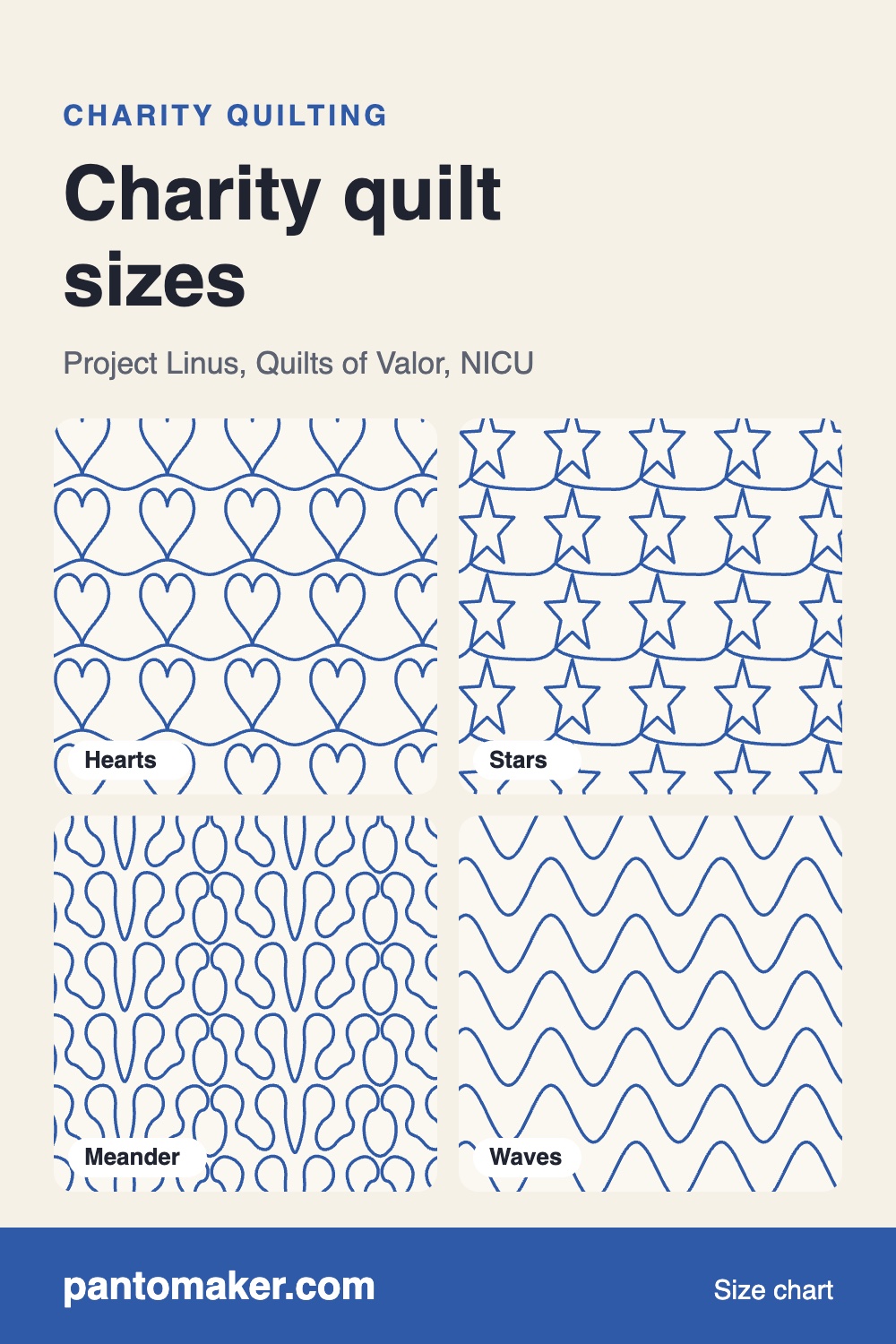
Hearts, Stars, Meander and Waves are four of the twelve classic designs in the free pantograph library. They're free all year in every longarm format plus a printable paper pantograph, and you can stitch them on any quilt, including quilts you donate or sell.


Hearts and Stars read well on children's quilts and Quilts of Valor alike. Meander is the quietest choice for busy piecing, and Waves is the most open, which suits a soft, drapey quilt if your batting allows the spacing. If you quilt by hand-guiding, you can print a paper pantograph at full size.
Before you stitch
As with any new pantograph, load the file, check the size your machine shows, and stitch a test row on scrap with the same batting and thread. Once the first quilt is done, the rest of the stack goes quickly at the same settings. If something looks wrong, email support@pantomaker.com with your machine and software version.